How to choose what type of Night Vision is best for my CCTV
If you only take one thing from this guide: for most people a Smart Hybrid Light camera is the best all-round choice, because it stays discreet most of the time and switches to a bright, full colour image the moment something moves. But the right answer depends on what you are trying to achieve, so here is how the three types of CCTV night vision actually differ, and how we would choose between them.
We have sold and tested these cameras since 2008, including setting them up at night in our own warehouse before we stock them, so the notes below are based on what we actually see rather than what the spec sheet claims.
1. Infrared (IR) night vision
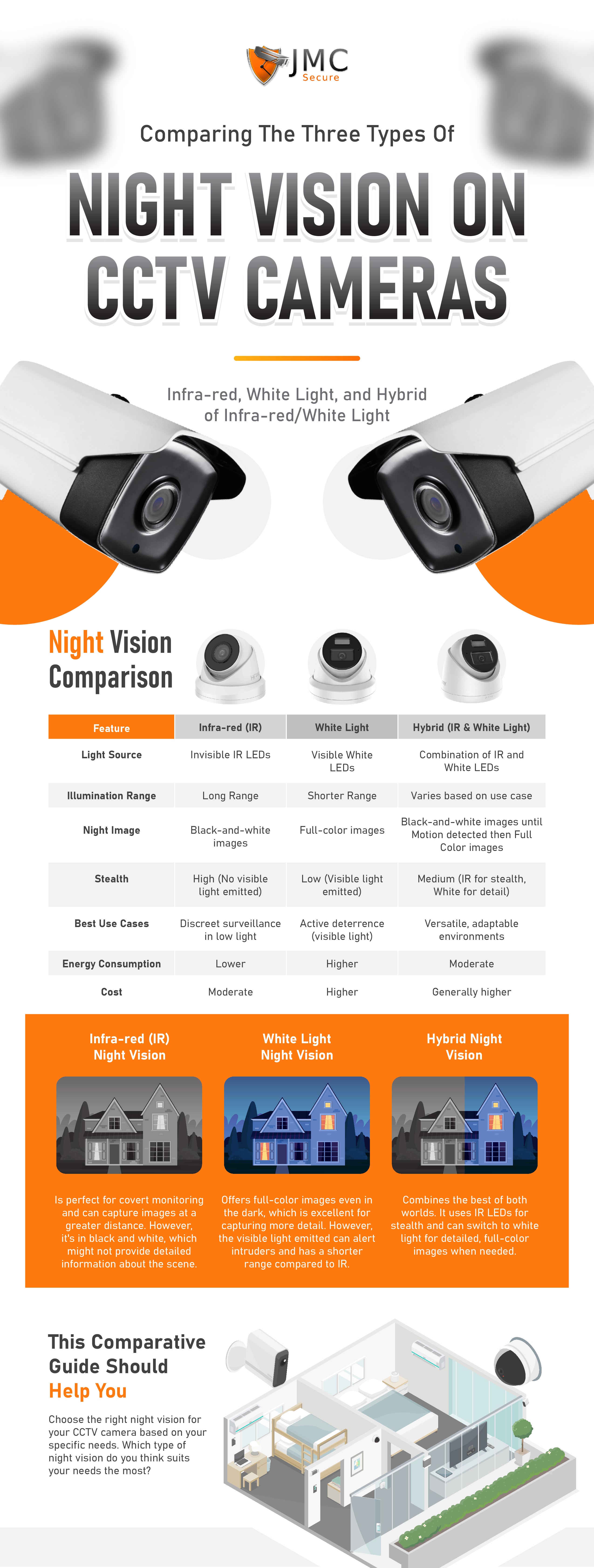
Infrared is the traditional form of night vision. The camera uses infrared LEDs, which the human eye cannot see, to light the scene, and produces a black and white image in complete darkness. Because the light is invisible, IR is the discreet, covert option. Nobody can tell the camera is lighting them up.
- Image: black and white.
- Visible to an intruder: no.
- Best for: covert monitoring, gardens, warehouses, anywhere you do not want a visible light burning all night.
The figure you see quoted on a product is the IR range in metres, commonly 30m, 40m, 60m, or 80m and above. Treat that as a best case in good conditions rather than a guarantee. A camera asked to identify someone right at the edge of its IR range, across a wide open area, will struggle, because the subject is both far away and made up of very few pixels. You get far better night results by positioning the camera where people pass close to it, a gate, a doorway, or a path, than by trying to cover a whole car park from one corner.
2. ColorVu (full colour night vision)
ColorVu is Hikvision’s name for full colour night vision. Instead of dropping to black and white, the camera holds a full colour image even in very low light, using a more sensitive sensor together with a built-in white light. The big advantage is identification. Colour tells you the colour of a car, a coat, or someone’s hair, which black and white simply cannot.
- Image: full colour, day and night.
- Visible to an intruder: yes, the white light is on, which doubles as a deterrent.
- Best for: entrances, shop fronts, commercial frontages, anywhere identification matters and a visible light is welcome.
The one thing to weigh up at home is that a constant white light can be a nuisance to you or your neighbours through the night. On a business frontage it is rarely a problem and the deterrent effect is a bonus, but for a back garden you may prefer the next option.
3. Smart Hybrid Light (our usual recommendation)
Smart Hybrid Light combines the two. By default the camera runs on discreet infrared in black and white, so it sits quietly. When the camera’s AcuSense detection spots a person or vehicle, it switches on the white light, giving you a full colour image of the event and acting as a visible deterrent at the same time. The rest of the time there is no light blazing away.
- Image: black and white normally, full colour when triggered.
- Visible to an intruder: only when motion is detected, which is exactly when you want it.
- Best for: almost everywhere, which is why it is our default recommendation for most homes and businesses.
You get the discretion of IR most of the time, colour and a deterrent at the exact moment something happens, and you avoid a light shining all night. For most customers it is the easy choice.
→ Browse our Smart Hybrid cameras
Which should you choose?
| Type | Image at night | Visible to intruder | Best for |
|---|---|---|---|
| Infrared (IR) | Black and white | No, fully covert | Discreet monitoring, gardens, warehouses |
| ColorVu | Full colour | Yes, constant white light | Entrances and shop fronts where identification matters |
| Smart Hybrid Light | Black and white, colour on motion | Only when triggered | Most homes and businesses (our pick) |
A real world warning: keep the lens clean
Whichever type you go for, night vision is only ever as good as the glass in front of it. A common problem we see is fingerprints or grime on the camera dome. In daylight the image looks fine, but at night the infrared light bounces straight back off the marks into the lens and washes the whole picture out. We filmed a short demonstration of exactly this happening: see how fingerprints cause IR bounce-back on a camera. It is worth a look before you mount a camera, and a good reminder to wipe the dome over now and then.
Still not sure?
If you want night vision explained as part of choosing a whole system, our CCTV buyers guide covers it alongside resolution, lens choice, and recorders. Or call us on 01902 213 999 and we will talk through what suits your property. There is no charge for advice, and you can browse our full camera range here.
The infographic below sums up the three types at a glance.